wto姐妹会
Chinese scientists develop ‘brain-reading’ AI model to help predict depression risk, may inspire future emotional-perception humanoids_我的网站

A | A former Oregon Department of Corrections employee who worked as a nurse at Oregon’s only women’s prison has been sentenced to 30 years in federal prison for sexually assaulting nine inmates while on the job.The man, 39-year-old Tony Daniel Klein of Clackamas County, Oregon, worked as a nurse from 2010 until January 2018 at the Coffee Creek Correctional Facility in Wilsonville, Oregon, when he abused his position of power and access to female inmates to engage in “nonconsensual sexual conduct with many female inmates entrusted to his care,” according to court documents per a statement released from the U.S. Attorney’s Office, District of Oregon.“In his position, Klein interacted with female inmates who either sought medical treatment or worked as orderlies in the prison’s medical unit, aided by his access to the women and his position of power as a corrections employee,” officials said.Klein, who was often alone with his victims, would “manufacture reasons to get them alone in secluded areas such as medical rooms, janitor’s closets, or behind privacy curtains,” the U.S. Attorney’s Office said in their statement regarding the case. “Klein made it clear to his victims that he was in a position of power over them, and they would not be believed if they tried reporting his abuse. Fearing punishment if they fought back against or reported his conduct, most of Klein’s victims submitted to his unwanted advances or endured his assaults.”A federal grand jury in Portland returned an indictment on March 8, 2022, charging Klein with multiple civil rights crimes. On July 25, 2023, a federal jury in Portland found Klein “guilty of 17 counts of depriving his victims of their constitutional right not to be subjected to cruel and unusual punishment by sexual assault and four counts of perjury.”Klein was ultimately sentenced to 360 months in federal prison and five years’ supervised release for his crimes on Tuesday.“Today’s sentence sends a clear message that using a position of authority to prey on individuals in custody will never be tolerated by the Department of Justice. Holding Tony Klein accountable for his crimes would not have been possible without the courage and resolve of the women he abused and the dedication of our partners at the FBI and Civil Rights Division,” said Natalie Wight, U.S. Attorney for the District of Oregon.Assistant Attorney General Kristen Clarke of the Justice Department’s Civil Rights Division echoed Wight’s sentiments.“The sentence in this case should send a significant message to any official working inside jails and prisons across our country, including those who provide medical care, that they will be held accountable when they sexually assault women inmates in their custody,” said Clarke. “Women detained inside jails and prisons should be able to turn to medical providers for care and not subjected to exploitation by those bent on abusing their power and position. We will listen to and investigate credible allegations put forward by people who are sexually assaulted and, where appropriate, bring federal prosecutions. The Justice Department stands ready to hold accountable those who abuse their authority by sexual assaulting people in their custody and under their care.”The case against Klein was investigated by the FBI Portland Field Office and was prosecuted by Gavin W. Bruce, Assistant U.S. Attorney for the District of Oregon, and Cameron A. Bell, Trial Attorney for the Civil Rights Division’s Criminal Section.“We know this prison sentence cannot undo the trauma Tony Klein inflicted on numerous victims, but we hope this brings them one step closer to healing,” said Kieran L. Ramsey, Special Agent in Charge of the FBI Portland Field Office. “As a state prison nurse, Klein abused his position and abused multiple women, violating the public’s trust, while doing everything he could to avoid being caught. The investigators and prosecutors should be applauded for their efforts to hold Klein accountable, but we recognize this lengthy sentence is also because of a group of brave women who came forward and helped ensure that Klein was held accountable for being a sexual predator within Coffee Creek Correctional Facility.”。

B |
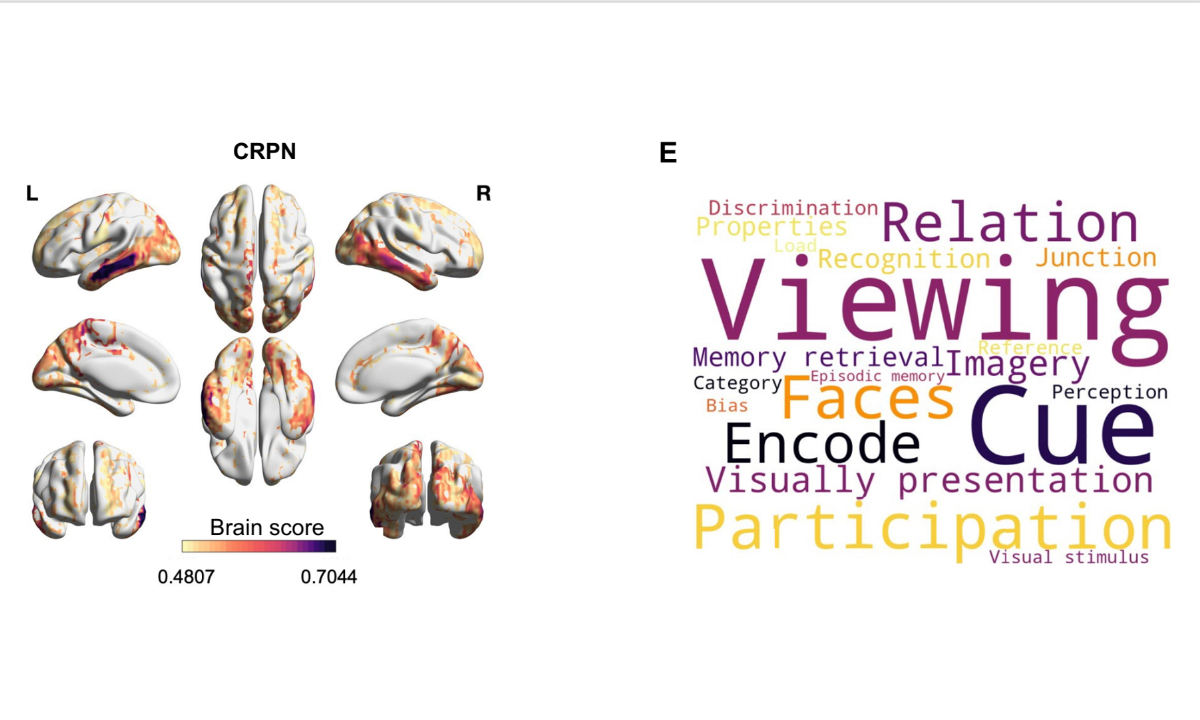
Brain-reading AI model reveals how different brain regions are linked to cognitive functions. Photo: Courtesy of Lu Han
Chinese scientists have developed a “brain-reading” AI model that could help predict the risk of depression among adolescents up to four years in advance by analyzing how humans respond to facial expressions, a technology expected to inspire future development of embodied intelligent humanoids capable of perceiving human emotion and thoughts through nuanced facial cues.
WHO data show that around 332 million people worldwide have depression, about one-third of whom have treatment-resistant forms of the condition. In China, an estimated 95 million people suffer from depression, National Business Daily reported, citing statistics from the China Mental Health Survey.
Using data from a population-based longitudinal adolescent cohort recruited across several European countries, the research team led by Lu Han, assistant professor at the School of Artificial Intelligence, Shenzhen University, has built an AI model that predicted which 19-year-olds were more likely to develop depression at the age of 23. The predictions were backed up by an independent clinical cohort of individuals with depression. The team’s paper was published in the journal Science Advances this month.
According to Lu, the study used brain scans taken at age 19 to predict depression-related symptoms at age 23. The study focuses on adolescence because the transition from adolescence to early adulthood is a key developmental period when depressive symptoms can increase rapidly. The earlier risks are identified, the greater the opportunity for prevention, Lu told the Global Times on Monday, adding that the findings need to be further validated in middle-aged and older adults and across different ethnic groups in future research.
In this study, the researchers analyzed data from adolescents in the IMAGEN, a population-based longitudinal cohort recruited across several European countries. At age 19, participants underwent an fMRI emotional-face task, and their emotional symptoms were assessed using standardized questionnaires. Genetic data obtained from blood samples were also analyzed, and participants were followed up at age 23. The researchers examined whether neural representations of angry faces at age 19 were associated with emotional symptoms and could predict elevated emotional symptoms four years later.
According to Lu, people without depression can more easily distinguish emotional changes based on others’ facial expressions and respond accordingly – for example, responding with friendliness to a smiling expression. But people with depression cannot do this, and are more likely to assume people are angry with them.
A brain-aligned deep-learning model developed by Lu’s team suggested that those participants whose brains were less able to distinguish between different facial emotions and tended to perceive others as angry were more likely to develop symptoms of depression and anxiety in adulthood.
The hypothesis that adolescents at risk of depression may respond differently to other people’s facial expressions than those without such risk based on the negative information processing bias long observed in depression research: people at risk of depression are more likely to notice, interpret, or remember negative social information, Lu said.
The researchers focused on angry facial expressions because they signal social threat and rejection, which are closely linked to interpersonal difficulties and negativity bias associated with depression. They hope to further understand how this bias develops within the visual system.
Building on this, they created a deep learning model, which mimics how the brain processes visual information, to predict how the brain encodes abstract emotional concepts such as anger.
They found that 19-year-olds whose response to facial expressions was skewed in favour of negative emotions or memories were the most likely to develop some form of depression.
Based on these findings, Lu’s team then developed a marker that can identify possible warning signs.
According to Lu, the study found that the computational biomarker was linked to the depression-related variant rs11123030 and polygenic risk for depression, suggesting that genetic susceptibility may affect emotional perception. It also provided predictive information beyond family stress and socioeconomic factors, complementing rather than replacing environmental risk factors. Therefore, depression is neither purely genetic nor purely psychological, but a complex mental disorder arising from the interplay of genetic susceptibility, brain development, emotional and cognitive processes, and life experiences.
According to Lu, the study is also expected to advance AI by aligning deep neural networks with human brain activity and using parameter perturbations to probe neural mechanisms, allowing models to both predict and explain how biases may arise.
The findings suggest that future affective computing and embodied AI should go beyond simply labeling facial expressions, incorporating visual details while preventing prior assumptions from overriding real-time sensory input, Lu said, adding that the findings could provide valuable insights for developing more interpretable robotic perception systems that more closely emulate the way humans process emotions.
。
Current article:http://www.qiniaohongfangfoguisenzhai.cyou/news/20260826_471.pptx
Published on:10:34:31


