绿巨人
Is Israel's Iron Dome missile defense system ironclad?_我的网站

一 | JERUSALEM -- Since Israel activated the Iron Dome in 2011, the cutting-edge rocket-defense system has intercepted thousands of rockets fired from the Gaza Strip.The system has given residents a sense of security, and Israelis can often be seen watching the projectiles flying through the skies and destroying their targets overhead.But the current war with Hamas might be its stiffest challenge yet.In just two weeks, Hamas has fired 7,000 rockets toward Israel, according to the Israeli military. That is more than any of the previous four wars fought between Israel and Hamas since the militant group seized power in Gaza in 2007. On Oct. 7 alone, the first day of fighting, Hamas launched at least 2,000 rockets, according to data from West Point. Lebanon's Hezbollah has also fired hundreds of rockets along Israel's northern front since the fighting began.Most of the rockets have been intercepted. But some have managed to get through, killing at least 11 people and hitting buildings as far away as Tel Aviv, according to Israeli officials.Here is a look at the accomplishments — and limitations — of the Iron Dome.The Iron Dome is a series of batteries that use radars to detect incoming short-range rockets and intercept them.Each battery has three or four launchers, 20 missiles, and a radar, according to Raytheon, the U.S. defense giant that co-produces the system with Israel's Rafael Defense Systems.Once the radar detects a rocket, the system determines whether the rocket is headed toward a populated area. If so, it launches a missile to intercept and destroy the rocket. If the system determines the rocket is headed to an open area or into the sea, it is allowed to land, thus conserving missiles. According to the military, all interceptions occur in Israeli airspace.The military declined to comment on how many Iron Dome batteries are currently deployed. But as of 2021, Israel had 10 batteries scattered around the country, each able to defend a territory of 60 square miles (155 square kilometers), according to Raytheon. It is roughly 90% effective, according to Rafael.But it can get overwhelmed if a mass barrage of rockets is fired, allowing some to slip through. While it has performed well so far, the risk could be raised if Hezbollah enters the war. Hezbollah has an estimated 150,000 rockets and missiles.Each missile costs an estimated $40,000 to $50,000, according to the Institute for National Security Studies, a Tel Aviv think tank.The U.S. has invested heavily in the system, helping with development costs and replenishing it during times of fighting.President Joe Biden has said he will ask Congress for $14.3 billion in military aid for Israel. The majority of that would help with air and missile defense systems, according to the White House.“We’re surging additional military assistance, including ammunition and interceptors to replenish Iron Dome,” Biden said.___Find more of AP’s coverage at https://apnews.com/hub/israel-hamas-war。
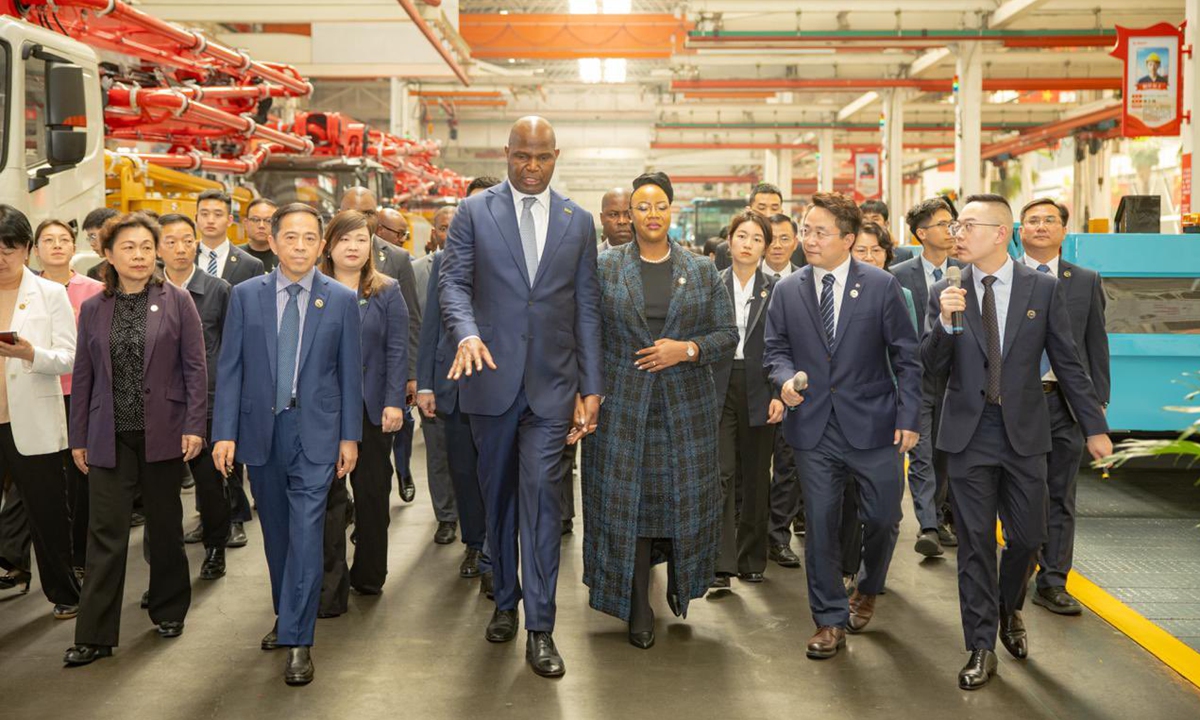
Mozambican President Daniel Chapo visits equipment manufacturer SANY Group in Changsha, Central China's Hunan Province, during his trip to China. Photo: X account of President Daniel Chapo
Central China's Hunan Province, a key locality in developing trade ties with African countries, aims to ramp up its foreign trade with Africa to 80 billion yuan ($11.86 billion) by 2028, according to a three-year action plan posted on the provincial government's website on Sunday.
The action plan focuses on 12 key African countries, aiming to build about 10 landmark projects involving production capacity cooperation and create one or two pilot projects under the "Two Countries, Twin Parks" model. The plan also aims to establish a service system for economic and trade cooperation with Africa.
The action plan highlights six of the province's competitive industries - mining, automobiles and parts, construction machinery, medical devices, modern agriculture, and green energy - and specifies differentiated and industry-specific development paths to form a full-chain and actionable road map.
The road map is one of the seven major measures outlined by Hunan to further improve trade and economic cooperation with African countries. The move is also aimed at tapping into a national policy that took effect on May 1, which expanded zero-tariff treatment to cover 53 African countries that have diplomatic relations with China.
In 2025, Hunan's trade with African countries totaled 58 billion yuan, ranking first for the seventh consecutive year among China's central and western provinces.
A Chinese analyst said on Sunday that as a locality and free trade zone that pioneers in China's trade and economic cooperation with African countries, Hunan enjoys a high level of industrial complementarity with African trading partners. Deepened cooperation between China and Africa will have particular significance amid the global headwinds of protectionism, said the analyst.
"The province's leading construction machinery sector could fit African countries' need to upgrade their raw material trade greatly and boost local industrialization. There is a perfect match of advanced Chinese production capacity with local development needs by these countries seeking to diversify their exports category," Song Wei, a professor at the School of International Relations and Diplomacy at Beijing Foreign Studies University, told the Global Times on Sunday.
Hunan has in recent years beefed up exchange and training programs for African experts, and emerging sectors such as agricultural products processing will serve as the new growth drivers of the province's cooperation with trading partners on that continent, building on the new opportunities brought by China's opening-up and a notable rise in African agricultural exports to China, Song said.
In particular, the action plan calls for improving supporting facilities for mining projects in Africa, expanding the scale of resource shipments back to China, boosting exports of mining equipment, and gradually building mining testing laboratories and setting up an investment fund for exploration in Africa in the mining sector.
The province also looks to increase exports of knocked-down vehicle kits, explore ride-hailing markets in key African countries, and expand used car exports in the automotive and parts sector and speed up product market certification to promote exports of medical equipment and supplies through China-Africa friendship hospitals in the medical device sector.
In the construction machinery sector, the action plan calls for improving alignment with Chinese-invested major infrastructure and mining engineering projects in Africa, expanding exports of branded machinery, and promoting exports of remanufactured construction machinery.
For modern agriculture, the province will set up integrated centers in Africa for agricultural machinery production, sales, and services, simultaneously cultivate projects that integrate production and trade, and coordinate the expansion of exports of competitive products and imports of distinctive African agricultural products.
In the first seven months of 2026, China's total trade with Africa reached 1.66 trillion yuan, up 18.9 percent year-on-year, closely trailing the growth rate of ASEAN at 20 percent year-on-year and making it one of China's fastest-growing trade partners.
The value of exports to Africa grew by 20.4 percent while that of imports shot up by 16.4 percent.
。
Current article:http://www.qiniaohongfangfoguisenzhai.cyou/kejcmv/20260826/538220.html
Published on:04:52:42


